The Narrator's Reeducation and Final Interrogation
The SympathizerThe unnamed narrator’s reeducation and final interrogation transform a year of coerced writing into a reckoning with what his confession has left unsaid. Isolated after an ambush, he is made to revise a 295-page confession until The Commandant judges its style, not merely its contents, satisfactory. The hidden examination then reveals that the crucial omission is not another political offense but the narrator’s failure to intervene when The Communist Agent was tortured. His eventual answer, nothing, completes the reeducation by exposing both the emptiness of political slogans and a meaning he had been trained not to recognize.
Confession and Isolation
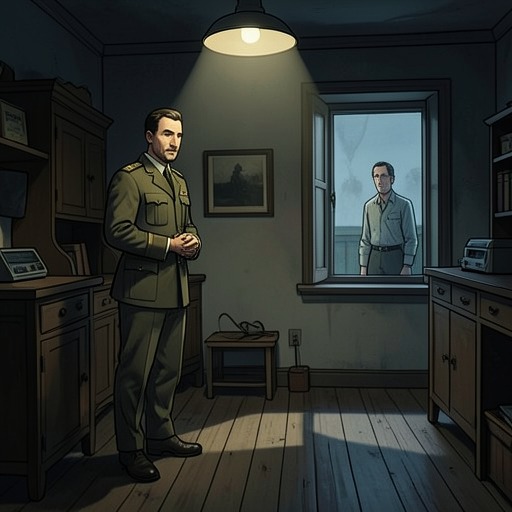
The final stage grows out of a year in a windowless, redbrick isolation cell. The narrator has been allowed out for only an hour of exercise each day and has spent the rest of the time rewriting his confession. At the opening of the examination sequence, The Commandant holds its final sheet above the 294 pages already stacked beside him. He marks the writing with a blue pencil, said to be the kind Stalin used, and treats himself as a diligent editor: correcting digressions and errata, and ordering passages deleted, reworded, or expanded. His attention to the document makes the confession a contested piece of writing as much as a record of conduct.
The Commandant calls the narrator a guest rather than a prisoner, then revises the description to patient. In his account, the narrator has traveled among dangerous ideas and must be quarantined until he is cured; exposure to foreign ideas, he argues, might harm people supposedly unprepared for them. The narrator can understand the logic of suspicion, having lived under suspicion himself, but that explanation does not erase the reality of the cell or its duration. The Commandant promises that an acceptable confession will lead to an oral examination and, the commissar hopes, the last stage of reeducation.
The distinction between the narrator and the camp’s other inmates sharpens the coercion. The Commandant points toward barracks housing a thousand prisoners, including Bon and survivors of the ambush, while describing the narrator as a special case and a guest of himself and the commissar. He is exempt from the prisoners’ political lectures, which the authorities consider elementary, and is instead required to write and reflect alone. Beyond the guard compound and its barbed-wire boundary, former soldiers, security officers, and bureaucrats of the defeated regime live in the exterior camp. Families reach a pavilion near the dividing fence only after arduous journeys and visit at most a few times a year. This landscape of confinement and separation surrounds the narrator’s supposedly privileged life of the mind.
The Hidden Examination
The Commandant insists that the narrator’s confession is unsatisfactory not because it lacks admissions, but because it lacks the expected form. Other prisoners, he says, describe themselves as puppets, imperialist lackeys, brainwashed stooges, or traitorous henchmen. Their repeated formulas tell the authorities what they want to hear; the narrator’s refusal to do so might signify intelligence or stupidity. The Commandant calls the confession a written examination and says the commissar will not permit the next, oral stage until the writing seems genuine. The pressure is therefore double: the narrator must confess, but he must also discover the sanctioned style of confession.
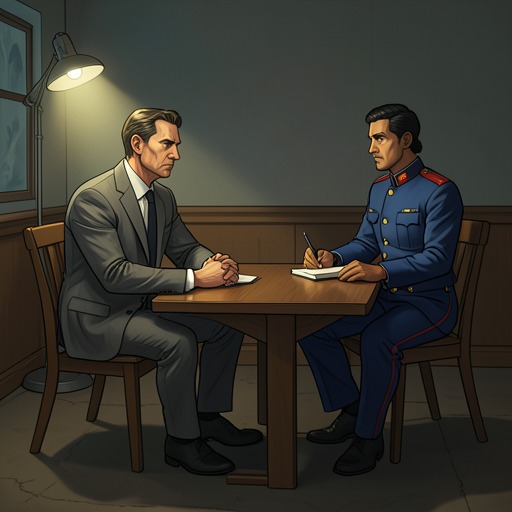
The revelation that Man is the commissar abruptly changes the meaning of this arrangement. Before the narrator can speak, guards seize, gag, and blindfold him, carry him less than a hundred paces, strip him, and bind him spread-eagled to a mattress. Foam around his hands and feet, earplugs beneath earmuffs, a hood, and the gag deprive him of ordinary sensory contact; he is left unable to see, hear, or call out. The mattress is startlingly soft after a year sleeping on planks, but that comfort belongs to the apparatus of restraint. The interrogation proceeds by controlling what the narrator can perceive and how long he must endure it.
Man explains that the Commandant considers his methods too gentle, and that both men must perform their roles until the Commandant is satisfied. He says the narrator has forgotten something, perhaps something never written down, and frames sleep deprivation as a way to open the safe holding the last of his secrets. When Man offers a test, the narrator expects a question he can answer through his familiar skill at examinations. Asked what is more precious than independence and freedom, he gives the apparent political answer. Man tells him it is nearly right, but not right. The examination exploits the narrator’s confidence in correct answers while withholding the context that would make the question intelligible.
Recovering the Movie Theater
Under questioning and extreme fatigue, the narrator finally remembers the room the police called the movie theater. When foreigners visited, it served as a theater; when they did not, interrogations took place there. He recalls the fluorescent-lit room, closed blackout curtains, folding chairs pushed against the walls, and a Sony projector facing a screen. The crapulent major watched from a chair, Claude stood by the projector, and three policemen conducted the interrogation. The Communist Agent lay naked and bound to a table covered with black rubber.
The narrator had watched beside Claude. Claude called the proceedings nasty business but told him to see them; The General wanted to know how the agent had obtained the names on the list, and the crapulent major said there was nothing he could do. The narrator objected that the interrogation was wrong and asked for time alone with her, but his protest did not stop what was happening. The recovered memory makes the omission in his confession precise: he had seen the violence, understood that it need not happen, and did not prevent it. The agent’s own position makes the memory more painful. She was The Communist Agent, a courier for Man, and had been caught carrying evidence in her mouth; the narrator’s name appeared on the list she was trying to swallow. He knew she did not know his true identity, while she knew Man’s.
The interrogation expands from that failure to other absences and intentions. The Commandant accuses the narrator not only of failing to sacrifice himself to save the agent, who was willing to risk her life for the commissar, but also of wishing his father dead. The narrator remembers having written that wish to Man, his revolutionary brother and confidant. The disclosure makes the letter more than an expression of anger: the recipient was someone who understood the narrator’s wishes and could act on them. Man confirms that The Communist Agent arranged the father’s death. The Commandant considers whether the narrator’s wish makes him deserving of guilt, while Man asks whether the life of the narrator’s father should count differently from the lives of Sonny and the crapulent major. Confession here cannot be reduced to a list of deeds; it must confront the gap between wanting, doing, and failing to act.
Nothing and the Completion of Reeducation
The final questioning returns repeatedly to the same test. The narrator proposes happiness, then love, and at last admits that he does not know. Man’s questions bring him to the desire he can no longer evade: he wishes he were dead. The narrator experiences himself as divided, seeing both child and adult in the same self, and links that division to the way others have called him a bastard. His account extends the fracture beyond the individual: Vietnam was partitioned and made a battlefield in a wider contest between powers, while the narrator was pressed to choose between sides that could not be separated within him.
His answer arrives through a radically different memory, the account of his birth. The narration moves backward to his mother’s womb, her heartbeat, his delivery, and the midwife cutting the frenulum beneath his tongue so that he could suckle and speak. In that bodily origin story, the word that had been present but unavailable finally becomes audible: nothing. The narrator screams it repeatedly, and with that word his reeducation is complete. The answer overturns the slogan-like question. Nothing can mean absence, but it can also name the paradox that nothing is, in fact, something; the narrator understands the joke where The Commandant hears only a dangerous negation.
Man embraces the narrator in the dark examination room and releases him from his bonds. The narrator’s sobbing turns to laughter as he explains that the answer is nothing, while The Commandant worries that his behavior will damage camp morale. When the narrator beats his forehead and head against the wall, Man and The Commandant help restrain him. The doctor returns him to the old isolation cell, now unlocked and unshackled, but physical release does not immediately restore ordinary life: the narrator is reluctant to leave corners, his eyes are sensitive to sunlight, and he sleeps or moves silently through the aftermath. The ordeal ends his pain without resolving the political exclusion that awaits him; the recovered memory and completed confession make departure from the revolutionary society the next necessity.